One of the most important questions anyone considering regenerative farming must ask is how the approach actually works at different scales. Many people assume that regenerative farming is only practical on small, hands-on operations, while others believe it can be rolled out across thousands of acres with the right systems. The truth sits somewhere in between. Regenerative farming scales successfully from tiny backyard plots all the way up to large commercial farms, but the methods, challenges, and management requirements shift significantly depending on the amount of land being worked.
Understanding these differences is essential for anyone planning a regenerative operation, whether they are starting with a quarter-acre garden or managing hundreds of acres. The core philosophy remains consistent, yet the practical execution changes in meaningful ways. This article explores how regenerative farming scales across different sizes of land, what stays the same, and what must adapt as the operation grows.
The Universal Principles of Regenerative Farming
At every regenerative farming scale, the fundamental principles remain the same. These principles focus on improving soil health, increasing biodiversity, minimizing soil disturbance, keeping the soil covered with living plants or residues, and integrating livestock where practical. Whether someone is managing a tiny backyard plot or a thousand-acre ranch, these core ideas form the foundation of the entire approach.
The reason these principles stay consistent is simple. Soil health is the base upon which everything else is built. When soil biology is thriving, plants grow more vigorously, require fewer external inputs, and become more resilient to weather extremes. Biodiversity above and below ground creates natural pest control and nutrient cycling. Keeping soil covered protects it from erosion and helps retain moisture. These outcomes are valuable at any scale, which is why the same principles apply whether the farm is measured in square meters or square kilometers.
What changes is not the destination, but the journey required to get there. The tools, timing, labor, and capital needed to implement these principles shift dramatically as regenerative farming scales increase.
Regenerative Farming at the Smallest Scales: Backyard and Micro Farms
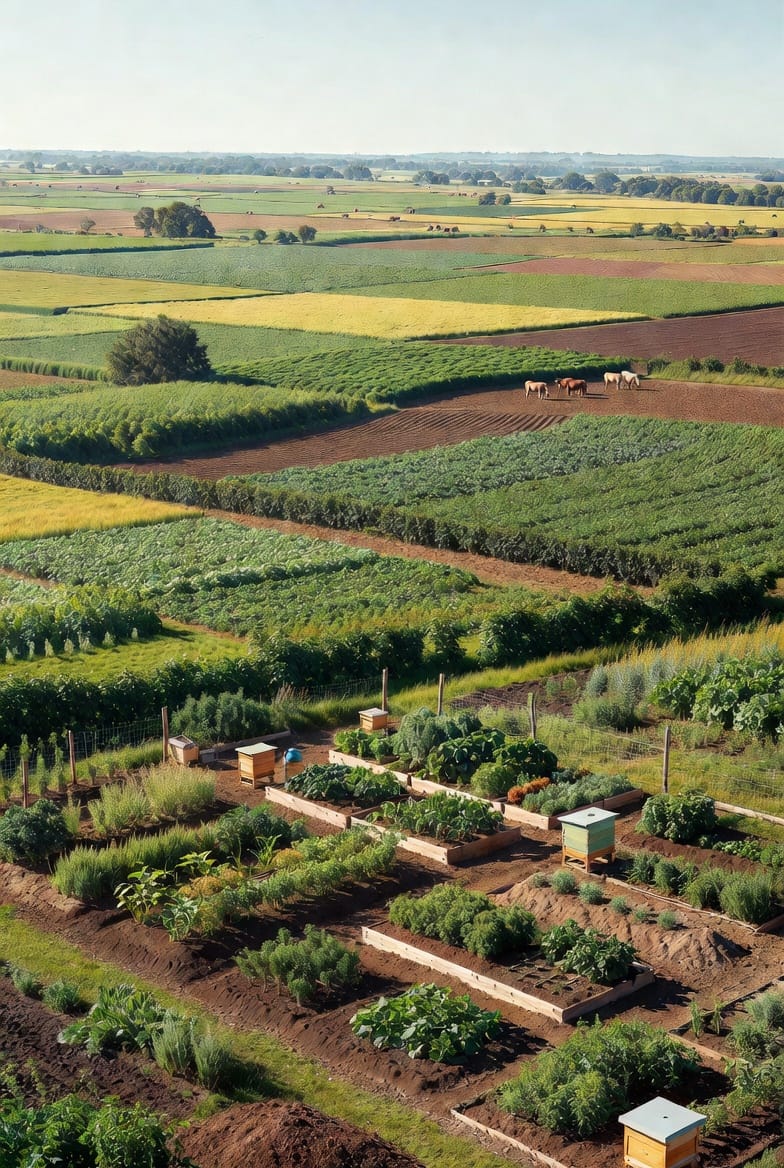
At the smallest regenerative farming scales, typically under five acres and often much smaller, the approach is highly intensive and personal. Growers working at this scale can use no-dig methods, hand-built compost systems, and dense interplanting of many different crops in the same space. They often maintain a few beehives and small numbers of chickens or rabbits that contribute to fertility and pest control.
One of the greatest advantages at this regenerative farming scale is the speed of learning and feedback. A person tending a quarter-acre garden can observe daily changes in soil structure, plant health, and insect activity. They can experiment with different cover crop mixes or mulching techniques and see results within a single season. This rapid feedback loop allows for quick adjustments and deep personal knowledge of the specific piece of land being worked.
However, small-scale regenerative farming also comes with clear limitations. Labor input per acre is very high because most tasks are done by hand or with small tools. While yields per acre can be impressive due to intensive management and high diversity, generating meaningful income is difficult without adding value-added products or direct marketing. Many backyard regenerative growers focus more on self-sufficiency and soil building than on commercial production at this stage.
Moving Up: Regenerative Farming at Medium Scales (5–100 Acres)
As regenerative farming scales move into the medium range, between roughly five and one hundred acres, new opportunities and challenges appear. At this size, it becomes impractical to do everything by hand, so growers begin incorporating light mechanization such as walk-behind tractors, small tractors, or specialized equipment for seeding cover crops and mowing.
Management complexity increases noticeably at this regenerative farming scale. Cover crop rotations must be planned across multiple fields or zones. Livestock integration, if used, requires fencing, water systems, and grazing planning that goes beyond simply moving animals daily. Record keeping becomes more important for tracking soil tests, input costs, and yields across different areas of the farm.
The medium scale offers a sweet spot for many regenerative farmers because it allows meaningful production while still permitting close observation of the land. A person managing twenty or thirty acres can still know their fields intimately, yet they begin to benefit from some economies of scale in equipment and marketing. This is the scale I am targeting with Beagle Rock Farms, and it represents a practical balance between hands-on management and commercial viability.
Regenerative Farming at Large Commercial Scales (100–1000+ Acres)
At the largest regenerative farming scales, from one hundred acres up to one thousand acres or more, the approach requires sophisticated systems thinking and significant infrastructure. Large operations that successfully practice regenerative methods typically use adaptive multi-paddock grazing, large-scale cover cropping with no-till drills, and precision tools for monitoring soil health across many fields.
One of the biggest shifts at this regenerative farming scale is the move from individual observation to data-driven management. Farmers managing hundreds of acres cannot walk every field daily, so they rely on soil testing grids, satellite imagery, and grazing planning software to make decisions. Livestock handling facilities, water infrastructure, and fencing systems must be designed for efficiency across large distances.
Large-scale regenerative farming can deliver impressive environmental outcomes, including meaningful carbon sequestration and improved watershed function, because the practices are applied across thousands of acres. However, the transition from conventional methods is often slower and more capital-intensive at this scale. Equipment costs are high, and the learning curve for managing complex biological systems across large areas can be steep. Some large operations have successfully made the transition by focusing first on grazing management before expanding into cropping changes.
What Remains Consistent Across All Regenerative Farming Scales
Despite the differences in methods, several important elements remain consistent no matter how large or small the operation. The commitment to building soil biology rather than depleting it is universal. The goal of reducing reliance on synthetic fertilizers and pesticides stays the same. The recognition that diversity in plants, insects, and soil life creates resilience applies at every regenerative farming scale.
Another consistent factor is the long-term mindset required. Regenerative farming is not a quick fix or a single-season strategy. Whether someone is working a backyard plot or managing a large ranch, meaningful soil improvement typically takes three to five years of consistent practice. This patient approach to land stewardship is one of the defining characteristics of regenerative farming at any scale.
What Changes Significantly as Scale Increases
As regenerative farming scales grow larger, several practical realities change in important ways. Labor requirements shift from being the primary input at small scales to being a major cost and management challenge at large scales. Equipment needs increase dramatically, moving from hand tools and small machinery to specialized no-till drills, large mowers, and livestock handling systems.
Financial risk also changes with scale. A person managing a quarter-acre garden can afford to experiment and even lose a season’s production without catastrophic consequences. At larger regenerative farming scales, a poor decision about cover crop timing or grazing management can affect hundreds of acres and create significant financial pressure. This reality often leads larger operations to move more cautiously during the transition period.
Marketing and sales channels also evolve. Small-scale regenerative growers often sell directly through farmers markets, community-supported agriculture programs, or on-farm stands. As regenerative farming scales increase, producers typically need to develop relationships with wholesalers, processors, or larger buyers who can move greater volumes of product.
Practical Considerations for Scaling Regenerative Practices
Anyone considering moving between regenerative farming scales should think carefully about several practical factors. Capital availability is often the first constraint. Transitioning to regenerative methods may require investment in new equipment, fencing, water systems, or soil amendments during the early years when yields or income may temporarily dip.
Knowledge and experience also become more critical as scale increases. Mistakes that are easily corrected on a small plot can become expensive problems when they affect dozens or hundreds of acres. This is one reason many successful large regenerative farmers began at smaller scales and gradually expanded as they developed confidence and systems.
Finally, the social and regulatory environment can differ at different regenerative farming scales. Small producers often face fewer regulatory requirements but may struggle with market access. Larger operations may have more regulatory obligations but can also access programs and certifications that provide financial or marketing advantages.
My Personal Approach at Beagle Rock Farms
For Beagle Rock Farms, I have deliberately chosen to begin at a manageable small-to-medium regenerative farming scale. This decision reflects both practical realities and long-term goals. Starting smaller allows me to develop deep knowledge of the land, test different techniques without excessive financial risk, and build the infrastructure and systems needed for future growth.
My focus is on soft fruit production, beekeeping, and value-added products rather than attempting to compete at commodity scale. This approach aligns with my £20,000
Why it Matters
Regenerative farming scales successfully from the smallest backyard plots to large commercial operations, but the path looks different at every stage. The core principles of soil health, biodiversity, and working with natural systems remain constant. What changes is the complexity of management, the tools required, the financial considerations, and the speed at which results become visible.
For anyone planning a regenerative operation, understanding these differences is essential for setting realistic expectations and making sound decisions. Whether the goal is self-sufficiency on a quarter acre or building a commercial enterprise across hundreds of acres, regenerative farming offers a powerful framework. The key is adapting the methods intelligently to the specific scale, resources, and goals of each individual farm.
At Beagle Rock Farms, I am committed to learning these lessons step by step, starting small and building strong foundations that can support growth over time. Regenerative farming at any scale rewards patience, observation, and a genuine respect for the living systems that sustain us.
If you’re already working with regenerative practices at any scale, whether you’re tending a backyard plot, managing a smallholding, or running a much larger operation, I’d genuinely love to hear from you. What’s been working well in your experience? What challenges have you faced when trying to scale regenerative methods, or when choosing to stay small? Leave a comment below and share your story. This journey is far more valuable when we learn from each other’s real experiences.
-Feniks
References
- Rodale Institute – Regenerative Agriculture Research
- Savory Institute – Holistic Management
- Soil Association UK – Regenerative Farming Guides
- GOV.UK – Sustainable Farming Incentive 2026
- Does Size Matter? Measuring the Impact of Scale in US Agriculture
- Higher Yields and More Biodiversity on Smaller Farms
- How We Scale The Regenerative Farming Model – Wanda Farms
- Scaling Regenerative Agriculture Challenges in the Food Industry