
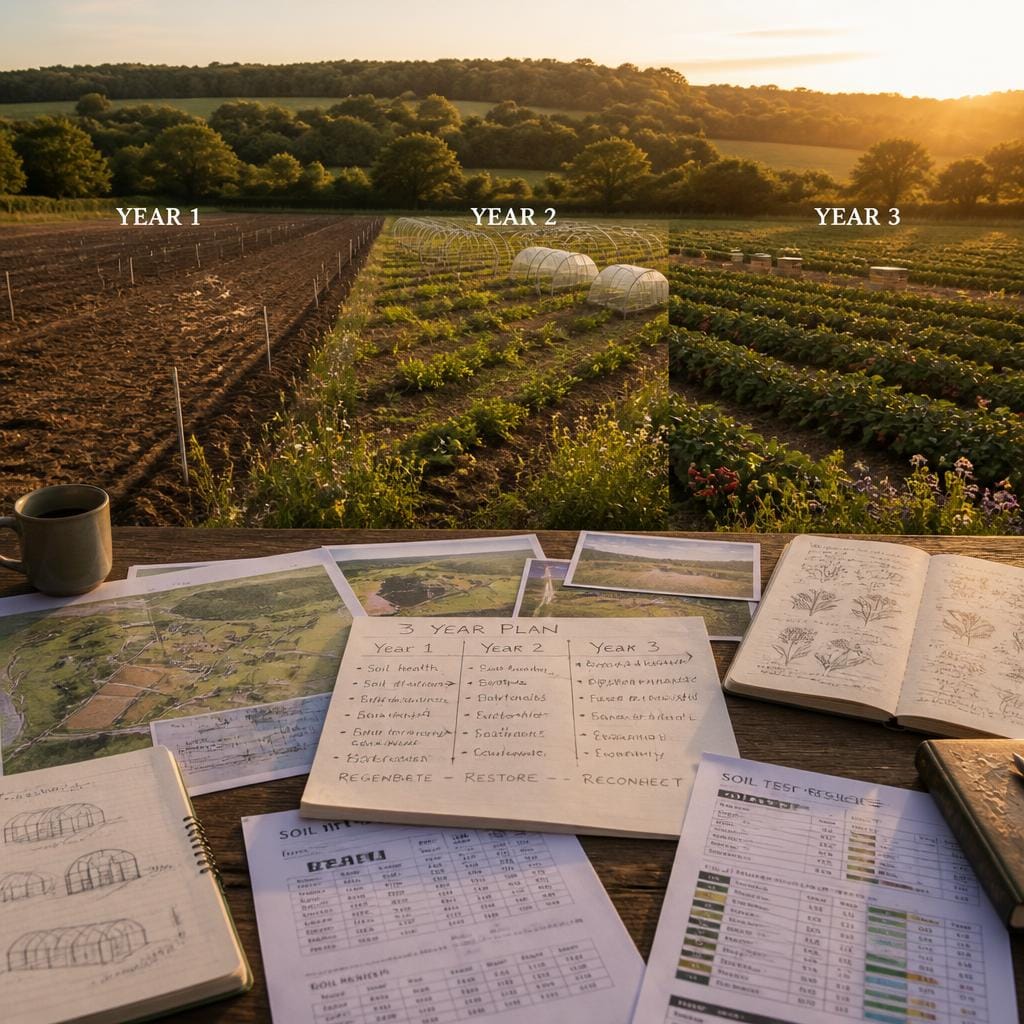
A realistic 3-year roadmap for starting a regenerative soft fruit farm on 8–20 acres in the UK, strawberries as the core crop, PYO revenue goals, beekeeping, and artisan value-added products.
Planning a regenerative soft fruit farm in the UK from scratch with a tight budget is both exciting and daunting. With a target land size of 8–20 acres in the North East of England, strawberries as the core crop, and a strong emphasis on Pick Your Own (PYO) as a major future revenue driver, I’ve spent considerable time developing a realistic 3-year roadmap for Beagle Rock Farms.
This article lays out my current regenerative soft fruit farm planning UK framework for Years 1–3. It is not a rigid business plan, but a living document based on ongoing research, budget constraints, and practical goals. The focus is on building strong foundations, generating early revenue where possible, and remaining flexible as I learn directly from the land.
Overall Strategy for Years 1–3
The first three years prioritize patience and intelligent setup rather than chasing maximum production immediately.
Year 1 focuses heavily on infrastructure, soil building, and initial planting. Year 2 emphasizes establishment and the first meaningful revenue streams. Year 3 shifts toward scaling production and value-added processing while continuing long-term soil improvement.
The guiding principles are simplicity, diversification within soft fruits, heavy reliance on bees for both pollination and income, and keeping operations manageable for a small team (primarily myself and my wife in the early years).
Year 1: Foundation and Soil Building (2027–2028)
Year 1 is dedicated to getting the land ready and establishing the core perennial systems without overextending the £20,000 budget.
Soft Fruit Planting Strategy Strawberries will form the core crop because they can produce fruit in the first or second year and work exceptionally well for PYO. Raspberries, blueberries, and blackcurrants will be planted in smaller numbers, with quantities guided by ongoing market research and specific site conditions once land is secured. The goal is a balanced mix that spreads risk and extends the harvest window.
PYO Revenue Goal I hope PYO can eventually contribute 50–70% of total revenue, but specifics will depend heavily on final location, accessibility, and how the planting develops. Early PYO strawberries and raspberries represent the most realistic starting point for generating cash flow while the farm is still young.
Beekeeping Integration Bees will be central to the entire system from day one. I plan to start with as many hives as the Year 1 planting can realistically support for pollination. This number will scale based on available forage and land conditions.
Supporting Veg & Herb Patch A dedicated vegetable and herb area will be sized large enough to supply fresh ingredients for sauces, salsas, chutneys, and rubs. The exact size remains flexible and will be determined by final land layout and soil conditions.
Infrastructure Priorities Key investments in Year 1 include at least one polytunnel (ideally a good used one to save money), basic crop protection such as fruit cages or netting, and a simple drip irrigation system. Fencing to protect young plants from rabbits and deer will also be essential. All infrastructure decisions will prioritize cost-effectiveness and regenerative principles.
Year 2: Establishment and Early Revenue (2028–2029)
By Year 2 the systems should begin maturing. Strawberries and raspberries should start producing reliably for PYO. Honey production will increase as hives strengthen. The veg and herb patch will expand to better support small-scale value-added trials in the home kitchen.
This year is primarily about learning the unique rhythms of the specific site, refining planting layouts, and beginning small-scale processing experiments. Soil health should show noticeable improvement, leading to stronger plant growth and better natural resilience.
Year 3: Scaling Production and Value-Added (2029–2030)
Year 3 represents the transition toward a more established operation. Soft fruit yields should increase significantly as plants mature and soil biology strengthens. PYO should become a core, reliable revenue stream during the harvest season. Honey production should be consistent, and we will begin scaling artisan, healthier value-added products using on-farm ingredients wherever possible.
By the end of Year 3 the farm should start showing clear signs of viability, with multiple income streams working together and soil health continuing to improve year after year.
Value-Added Products Strategy
The long-term vision is to move beyond raw fruit sales into higher-margin artisan products. Focus will be on healthier options using farm-produced honey instead of refined sugar. Planned flavors include spicy strawberry, raspberry mint, lavender-infused honey, cherry-chilli marinades, and similar creative combinations. The small veg and herb patch will play a key supporting role by supplying fresh ingredients for sauces, chutneys, and rubs.
Key Principles Guiding the Plan
Every decision is designed to stay within the £20k budget, remain manageable for a small team, and prioritize long-term soil health as the true foundation of the farm. Flexibility is intentionally built in — final planting ratios, infrastructure choices, and product development will be adjusted based on what the land and early market feedback tell us during the first couple of years.
Conclusion
This 3-year planning framework for regenerative soft fruit farm planning in the UK is realistic, flexible, and grounded in the constraints I’m working with. Strawberries as the core crop, PYO as a major revenue goal, bees as a central element, and a strong focus on artisan low-sugar value-added products form the backbone of the plan.
The journey will evolve as I learn directly from the land, but having a clear roadmap helps reduce overwhelm and keeps decisions aligned with long-term viability.
If you’re planning or already running a regenerative farm, I’d genuinely love to hear how you approach your first three years. What worked well? What would you do differently? Leave a comment below, sharing real experiences makes this journey stronger for everyone.
References
- Royal Horticultural Society – Soft Fruit Growing Guide
- AHDB – Soft Fruit Production in the UK
- Soil Association – Regenerative Horticulture Resources
- East Malling Research – Strawberry and Raspberry Variety Trials
- James Hutton Institute – Blueberry Cultivation in the UK
- DEFRA – Sustainable Farming Incentive