Bees on a Regenerative Farm
One of the first major decisions I made while planning Beagle Rock Farms was that bees would not be an afterthought. In regenerative farming, bees are central to the entire system. They are true ecosystem engineers that drive pollination success, support soil health, boost biodiversity, and help create a resilient farm. After extensive research, I’m convinced that bees will literally be at the heart of our soft fruit operation in the North East of England.
The Critical Role of Pollination in Soft Fruit Production
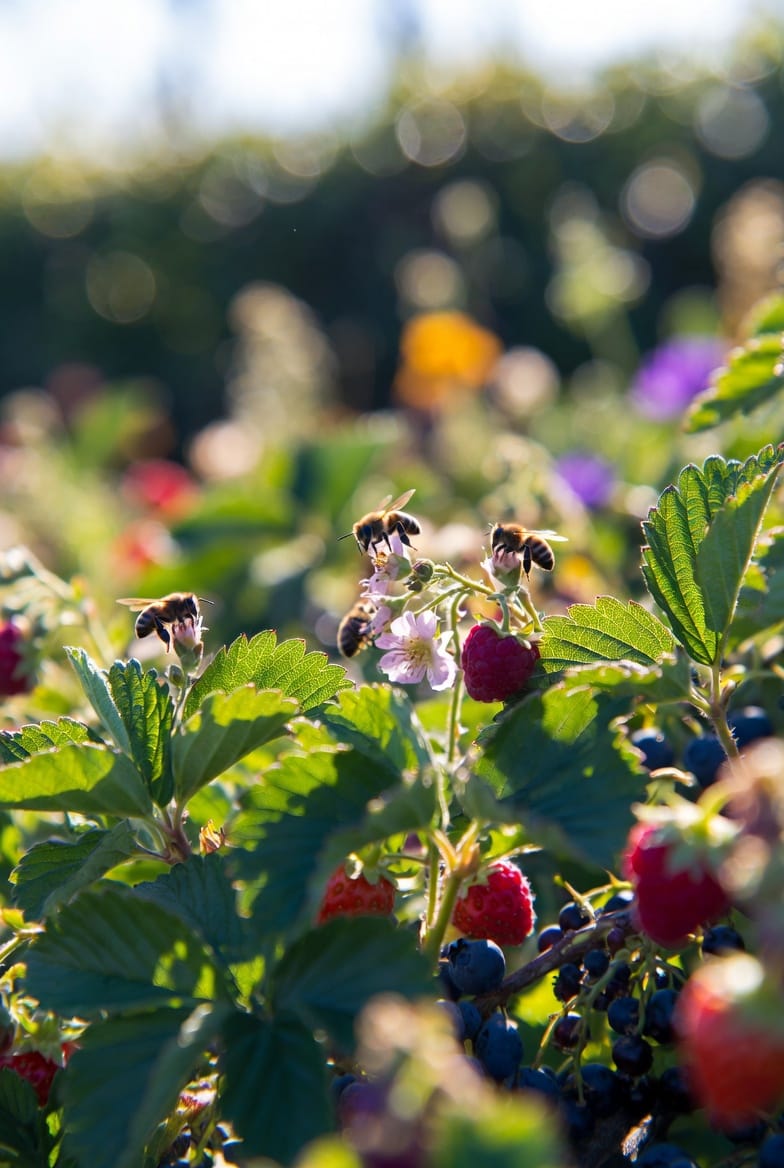
Soft fruits such as strawberries, raspberries, blueberries, and blackcurrants depend heavily on insect pollination. Studies show that good pollination can increase yields by 20% to 50% while also improving fruit size, sweetness, and uniformity. A 2024 study published in Nature Ecology & Evolution found that insufficient pollinator visits frequently limit crop yields across the world. Blueberries and raspberries especially benefit from multiple bee visits to each flower. When honey bees and wild bees work together, the results are significantly better than relying on one type alone.
Bees Drive Biodiversity and Ecosystem Stability
Regenerative farms succeed through diversity, and bees are one of the best drivers and indicators of that diversity. As they pollinate not only our fruit crops but also wildflowers, hedgerows, and cover crops, bees support a wide web of life. This increased plant diversity then creates better habitats for insects, birds, and soil organisms. Research from the University of Reading in the UK has shown that regenerative and agroforestry sites can support up to 2.4 times more bumblebees and significantly higher bee species richness compared to conventional monoculture fields.
Bees Contribute to Soil Health
Bees also play an important indirect role in soil regeneration. By successfully pollinating plants, they enable stronger plant growth, deeper root systems, and greater biomass production. This leads to more organic matter returning to the soil through fallen leaves and root exudates, which feeds the microbial life underground. Additionally, ground-nesting wild bees help aerate the soil as they create their nesting tunnels. These small but meaningful contributions support the living soil that is the foundation of any regenerative system.
Why Bees Are Central to Our £20k Challenge
For a small startup farm working with a tight £20,000 budget, bees offer one of the highest possible returns on investment. A few hives can dramatically improve fruit yields and quality while providing free, natural pollination services that reduce or eliminate the need to rent commercial hives each season. At the same time, they open up multiple income streams through honey sales and value-added products such as infused honeys and honey-sweetened jams. All of this happens while actively supporting biodiversity and long-term soil health across the farm.
Honey Production as a Diversified Income Stream
Beyond pollination, healthy bee colonies will provide another reliable revenue stream. In a regenerative system, the honey produced is often higher quality because bees forage across a diverse range of chemical-free flowers and plants. This aligns perfectly with our plan to create artisan products using honey instead of refined sugar, moving from raw fruit sales to higher-margin finished goods.
The Plan for Beagle Rock Farms
I plan to start with a substantial number of honey bee colonies while actively encouraging wild bees through diverse planting, hedgerows, and areas of undisturbed ground. This combined approach, managed honey bees plus strong habitat for wild bees, is one of the most effective strategies supported by current research for regenerative farms.
Bees will be at the very heart of Beagle Rock Farms. They will drive pollination, support soil life, increase biodiversity, and help build multiple income streams from the beginning of this five-year journey.
References
- Insufficient pollinator visitation often limits yield in crop systems worldwide – Nature Ecology & Evolution, 2024
- Regenerative Agriculture and Pollinator Recovery
- Bees and Agriculture: A Critical Symbiotic Relationship
- University of Reading studies on pollinators in regenerative systems